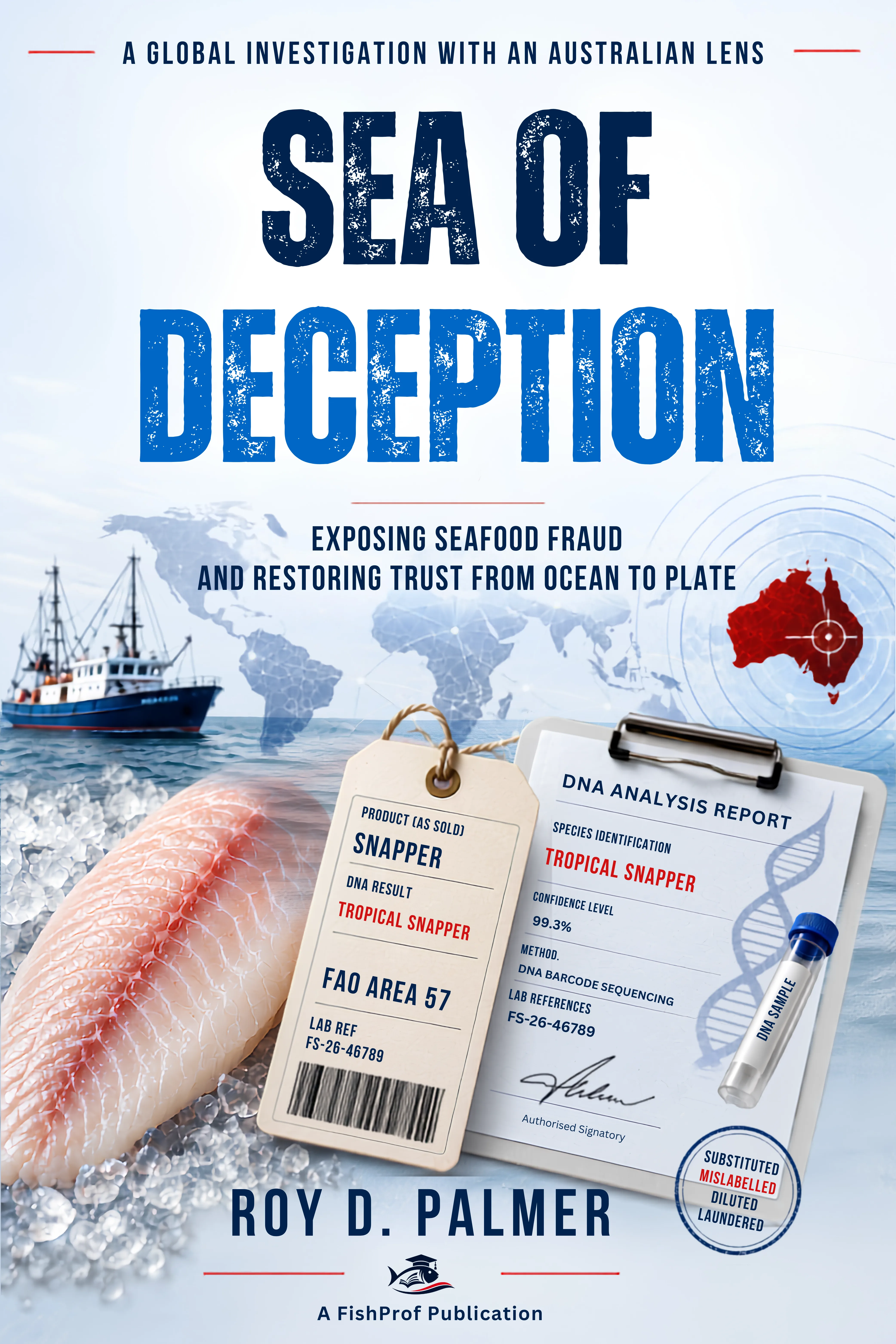
In a world where seafood nourishes billions yet hides billions in deception — this is the unvarnished truth, and the tools to fight back. The book that founded the I-CADMUS framework.
After fifty years in the seafood industry, I kept coming back to the same observation: the same kinds of fraud were happening over and over, in every market I worked in, under different names and different cover stories. Substitution. Dilution. Adulteration. Illegal laundering. The categories were never new — but nobody had named them, classified them, or given them a shared language.
So I did. Seven categories. One taxonomy. Sea of Deception is the book that walks through each, with the cases, the cover stories, the policy gaps, and the playbook to close them. It's written for the consumer who walks up to the counter and wants to know what's really in the pack — and for the regulator who's tired of writing rules that fraudsters route around.
This book isn't despair. It's a playbook.
The framework, the certification course, and the open publications register at i-cadmus.org are all built around the chapters of this book. Read the book first; then come back here to test what you've learned against the eight live case studies in Chapter 14.

From the conditions that make seafood fraud possible, through the seven categories of the I-CADMUS taxonomy, to the policy playbook and the consumer steps you can take Monday morning.
The conditions fraud needs: long opaque supply chains, weak labelling laws, fragmented regulation, and consumers who can't visually distinguish species or detect adulteration.
One chapter per fraud type. Definition, mechanism, real-world examples, red flags, counter-measures. The technical heart of the book.
Why voluntary standards fail. Why fragmented jurisdiction creates laundering pathways. Why the "processed in" loophole undermines origin labelling.
Mandatory naming, DNA verification, real penalties, supply-chain transparency, consumer rights — the policy framework that closes the gaps.
What the next decade looks like: cheap DNA testing, traceability technology, a generational low in consumer trust, and the political opening they create.
What you do on Monday morning at the supermarket. What you ask the waiter. How you spot a label that lies. How you join the I-CADMUS-certified network.
Chapter 14 sets eight real-world scenarios. Read them, classify the fraud type using the I-CADMUS framework, then submit your answers on i-cadmus.org. Compare your accuracy against industry, regulators, and certified consumers worldwide. Answers and certification available at i-cadmus.org.
Each case is drawn from real investigations. After reading, classify which I-CADMUS category (or combination) is at play. Submit your answers at i-cadmus.org and benchmark against the global certified network.
A national chain advertises Australian snapper at a price 60% below market wholesale. Investigation reveals…
Substitution suspectedA 1kg pack of frozen prawns weighs 612g after thawing. The label declares "5% glaze."
Dilution + MisrepresentationA "wild-caught Atlantic salmon" promotion runs in February. There is no commercial wild Atlantic salmon fishery.
MisrepresentationAn MSC-marked tuna imported in volume can't be matched to any record in the certifier's public database.
CounterfeitA high-end restaurant lists "wild-caught local scampi" at $90/kg. The supplier can produce no traceability documentation.
UnreportedPremium scallops cook out 35% of their packed weight. The ingredient panel lists "scallop, water."
AdulterationA consignment of yellowfin tuna shows port-state records inconsistent with vessel AIS data over a six-week period.
Illegal · IUUDNA testing of "fish of the day" specials across 30 restaurants finds 18 different species under the same name.
Substitution"The first time anyone has given me a single language for what I've been seeing for years across procurement audits."
"An indispensable framework. The case studies in Chapter 14 alone are worth the cover price for any seafood policy practitioner."
"I will never look at a supermarket fish counter the same way again. Palmer has written the consumer's missing manual."
Preorders ship at launch in 2026 and include access to the I-CADMUS certification course alongside the book.
Hardcover, 320 pages. Includes complimentary access to the online I-CADMUS certification course (normally available separately) and downloadable copies of the framework whitepaper and policy playbook.
The book pairs with the certification course — read the framework, then test yourself on the case studies and join the certified network.