Supporters Newsroom Careers Partners Contact
๐ŸŒ
A Seafood Consumers Association Ltd initiative ยท Est. 2026

Restoring trust from ocean to plate, one classified fraud at a time.

I-CADMUS is the practical framework that exposes seafood fraud's seven core types โ€” built on five decades of supply-chain experience. We help consumers, industry, and regulators spot risks, classify fraud, and act before HACCP ever begins.

Informed by
Relevant standards Research Industry engagement
Featured Insight

Why food safety must start with truth in labelling

Research has identified seafood mislabelling across international markets, while excessive or inadequately declared glaze and added water can also misrepresent the quantity of seafood being purchased. We walk through what the next decade of seafood integrity looks like โ€” and how I-CADMUS complements HACCP, TACCP and VACCP.

7
Fraud categories
50+
Years of expertise
Read the report โ†’
50+
Years of expertise
Decades on the water and across the supply chain.
7
Fraud categories
A complete, shared taxonomy for industry use.
8
Real case studies
Test your skills with live examples in Chapter 14.
1
Professional education programme
In development โ€” register your interest.
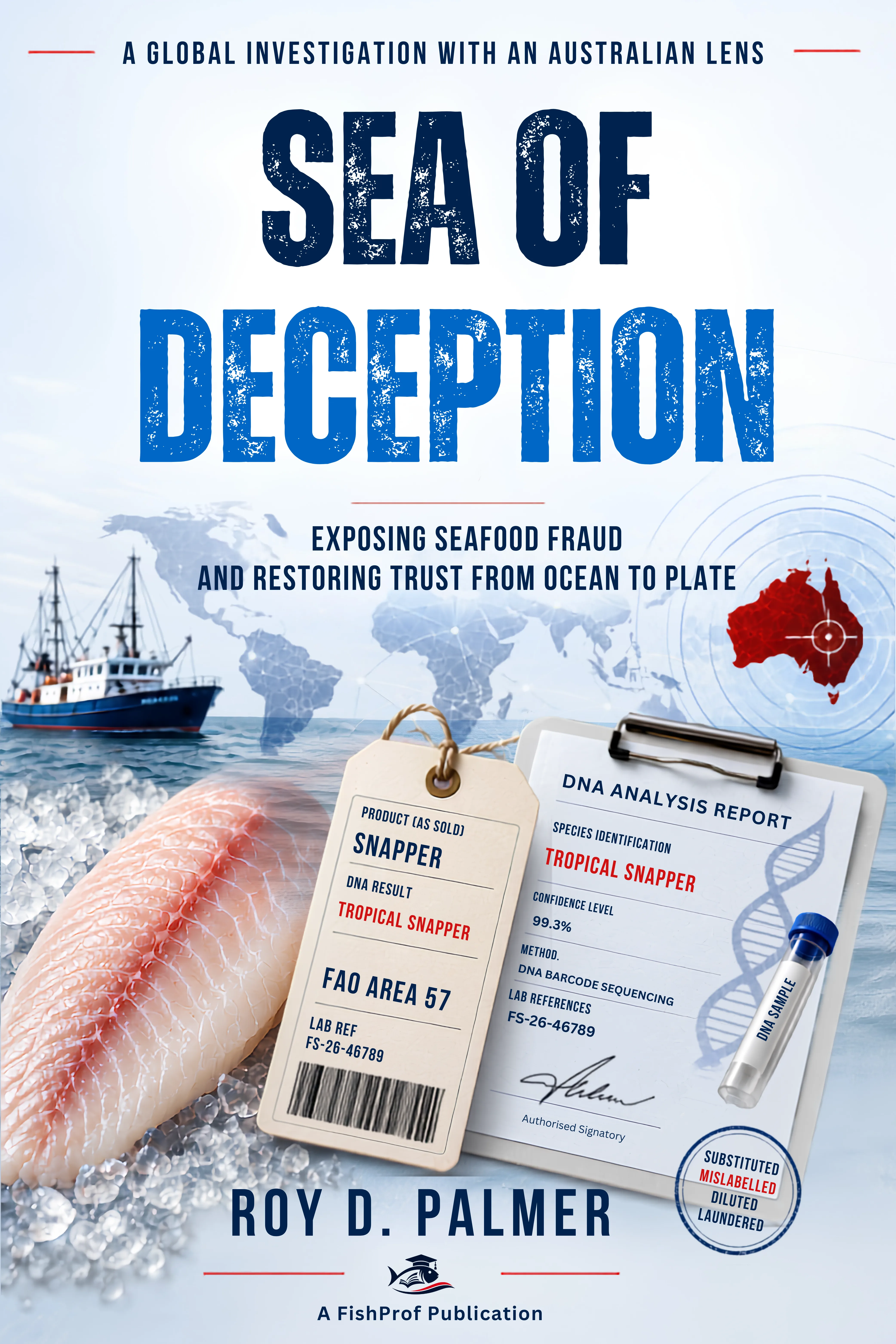
Sea of Deception โ€” back cover Sea of Deception โ€” front cover
Publishing Soon

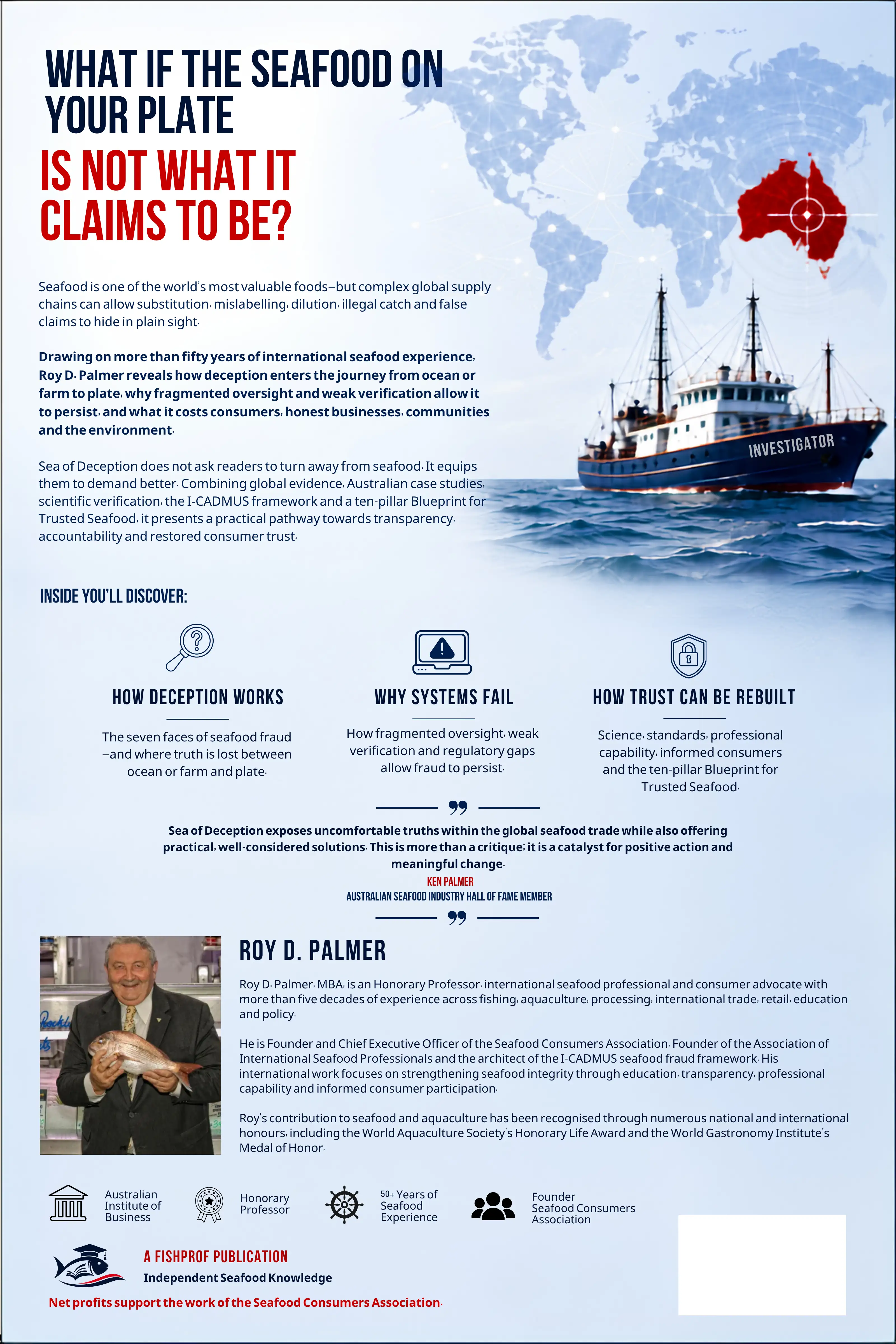
What if the seafood on your plate is not what it claims to be?

Five decades of industry experience. Seven categories of fraud. One framework to stop them. Sea of Deception by Roy D. Palmer, MBA is heading to publication โ€” register your interest and be first to know.

Who we are

A practical framework, born from five decades in the industry.

I-CADMUS classifies seafood fraud into seven actionable categories. Designed to complement HACCP, TACCP and VACCP, the framework turns suspicion into capability โ€” giving consumers, industry, and regulators a shared vocabulary for what's actually happening in the global seafood supply chain.

Published by the Seafood Consumers Association Ltd, the framework is paired with the forthcoming book Sea of Deception, a developing professional education programme, and a network of academic and industry partners.

โœ“
Built on global supply-chain reality

Drawing on direct industry experience across five continents.

โœ“
Aligned with international standards

Designed to integrate with AS 5300 naming and Codex traceability.

โœ“
Independent, not-for-profit led

Developed by the Seafood Consumers Association Ltd with academic partners.

Research

Forensic DNA Barcoding Accuracy

Forensic DNA Barcoding Accuracy (94โ€“100%): In targeted retail testing (such as studies published in Food Control and Conservation Biology by Willette et al. and Luque & Donlan), DNA barcoding targeting the mitochondrial COI gene consistently delivers a 94% to 99% species-level resolution rate when authenticating commercial finfish against reference databases.

94โ€“100%
Species-level resolution

DNA barcoding accuracy in targeted retail testing (Willette et al.; Luque & Donlan).

The Global Picture

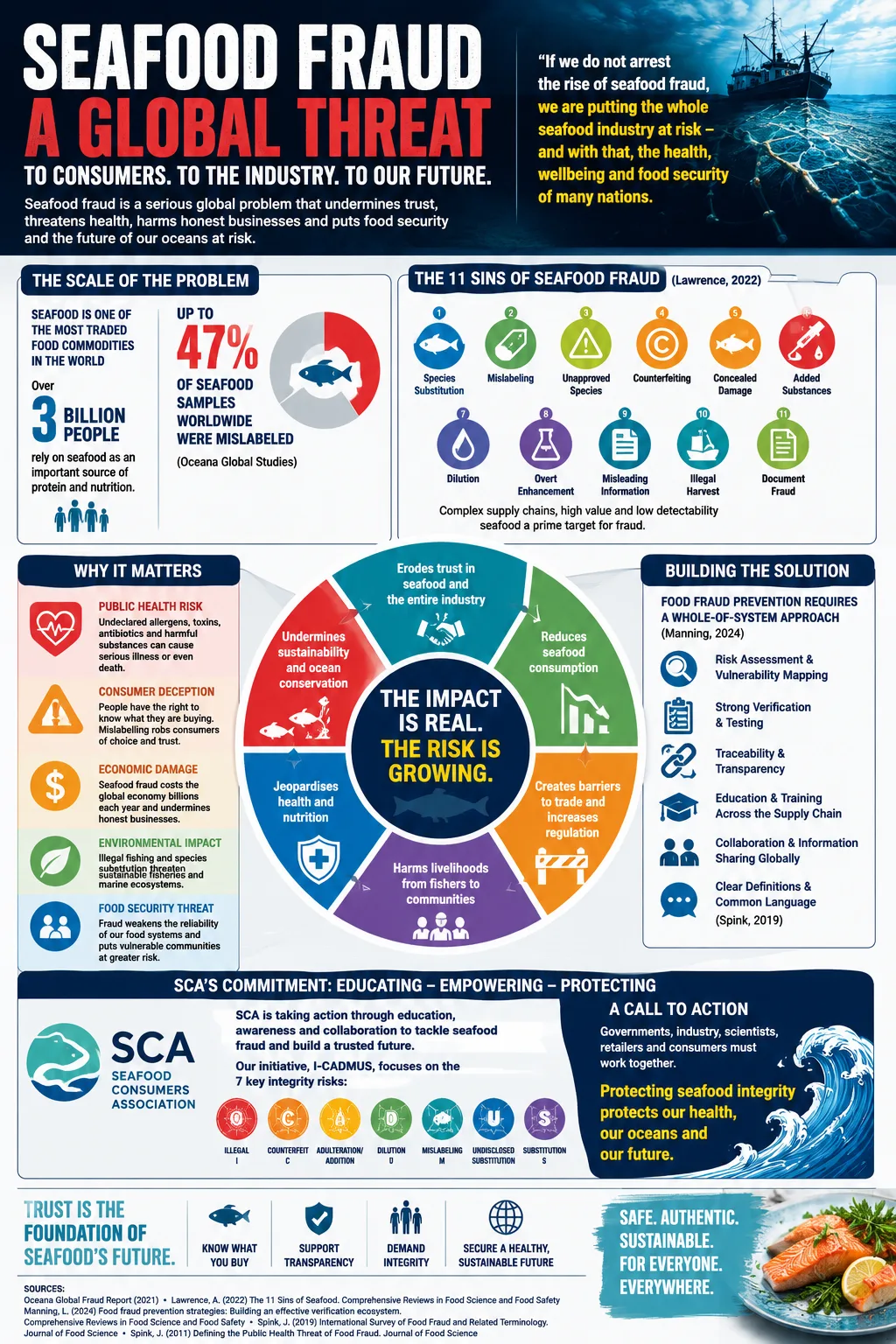
The scale of global seafood fraud.

According to global economic modelling from the University of British Columbia's Institute for the Oceans and Fisheries (Sumaila et al.), illicit trade, laundering, and fraud in the seafood sector generate an estimated global economic loss of between USD $26 billion and $50 billion each year.

Large-scale DNA authentication studies โ€” most notably multi-city market investigations by Oceana and university researchers published in Conservation Biology (Willette et al.) โ€” have documented seafood mislabelling rates reaching up to 47% across retail and restaurant channels.

According to the UN Food and Agriculture Organization (FAO), over 3 billion people rely on seafood as a primary source of protein and essential nutrients โ€” meaning systemic seafood fraud, species substitution, and IUU laundering directly threaten global food security, public health, and livelihoods on a massive scale.

Seafood Fraud Infographic
Click to expand
The Framework

Seven categories. One shared language for seafood fraud.

View full framework โ†’
I
Category 01 ยท Illegal

Illegal (IUU)

Catch from illegal, unreported, and unregulated fishing washed into legitimate supply chains through paperwork laundering and port-hopping.

Learn more โ†’
C
Category 02 ยท Counterfeit

Counterfeit

Forged certifications, fabricated origin claims, and entirely manufactured brand identities โ€” fake labels printed onto otherwise unknown product.

Learn more โ†’
A
Category 03 ยท Addition/Adulteration

Adulteration

Phosphates, sulphites, brines, and undisclosed additives โ€” chemicals and water bulking weight and masking age, with real consequences for vulnerable consumers.

Learn more โ†’
D
Category 04 ยท Dilution

Dilution

Ice glaze padding the scale and cheaper species blended into a premium pack โ€” glazing and mixing that mean you pay for fish but receive water and filler.

Learn more โ†’
M
Category 05 ยท Misrepresentation/Mislabelling

False Origin & Labelling

"Wild-caught" that wasn't. "Local" that flew across an ocean. Country-of-origin and method claims that simply don't match reality.

Learn more โ†’
U
Category 06 ยท Unreported/Unregulated/Undisclosed

Unreported

Product that bypasses traceability โ€” moved through grey channels and unregulated routes, off the books, and into the menu without a trail.

Learn more โ†’
Who we serve

Built for every stakeholder in the seafood value chain.

From the consumer at the counter to the regulator drafting policy, I-CADMUS provides a single, shared framework for spotting and acting on seafood fraud.

01

Consumers

Tools, scorecards, and the language to ask the right questions at the counter.

Consumer hub โ†’
02

Retail & Foodservice

Audit checklists, supplier verification protocols, and staff training modules.

For business โ†’
03

Processors

Supply-chain mapping, DNA verification workflows, and risk classification.

For industry โ†’
04

Regulators

A workable taxonomy that aligns with AS 5300 and international Codex standards.

For policy โ†’
Our methodology

A proven path from awareness to capability.

Three stages. Self-paced. Free to start. Built around the way real consumers, retailers, and regulators absorb and apply new frameworks.

01

Learn the framework

Read Sea of Deception and the supporting framework guide. Understand each fraud type with real examples, red flags, and the underlying supply-chain conditions.

Approx. 6โ€“8 hours
02

Test on real cases

Chapter 14 sets eight real-world scenarios. Submit your classifications on the platform and benchmark against industry, regulators, and other participants worldwide.

2โ€“3 hours of practice
03

Professional Education โ€“ In Development

A professional education programme is being developed. Register your interest to be notified when enrolment opens.

Programme in development
Insights & Research

Latest thinking on seafood integrity.

Research, case studies, and policy briefings from the I-CADMUS team and our academic partners.

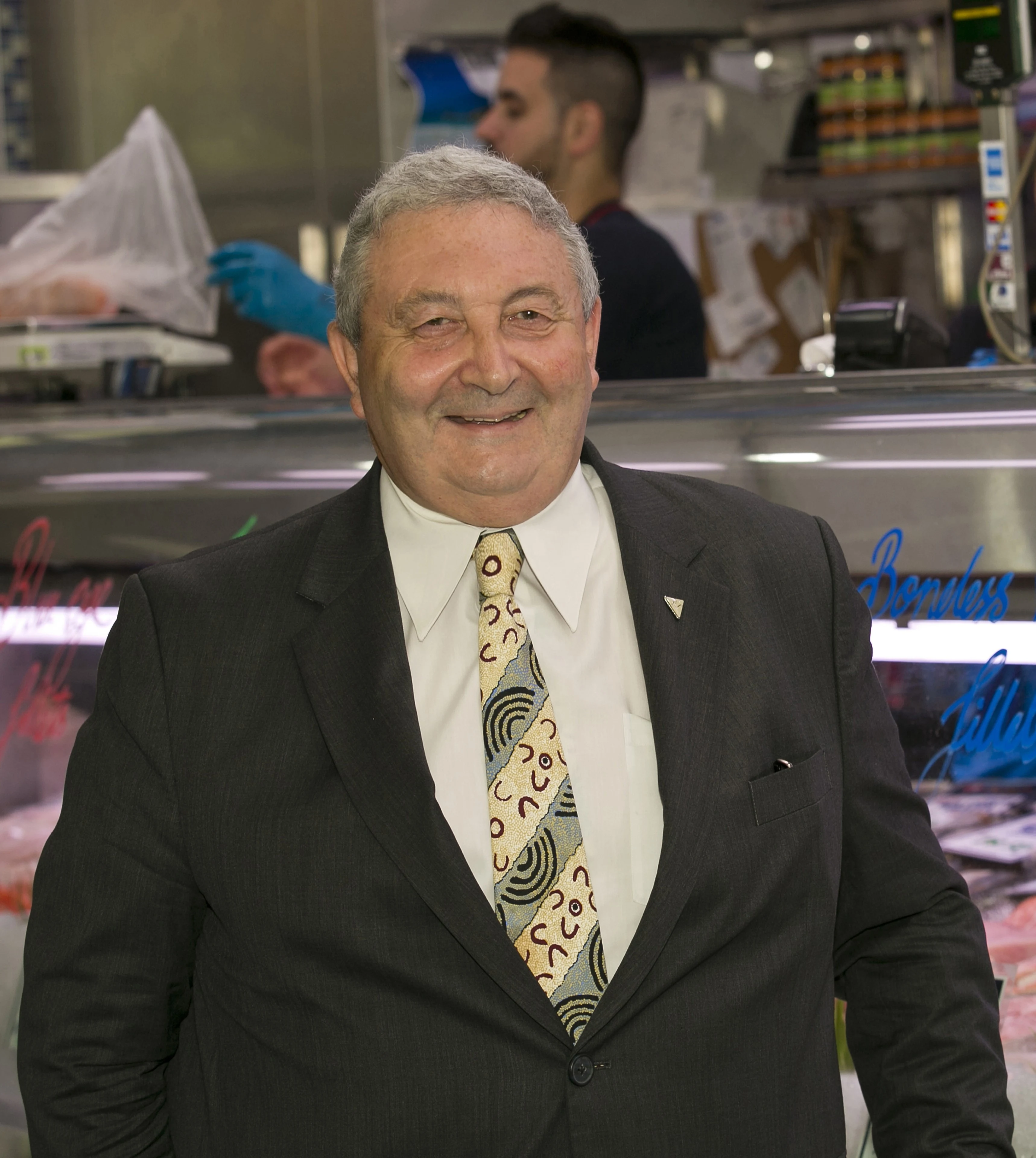
Hon Prof Roy Palmer
From the Founder
Seafood isn't just food โ€” it's a sacred trust between ocean and plate. The work of I-CADMUS is to make that trust verifiable, repeatable, and shared across every level of the supply chain.
Hon Prof Roy D. Palmer, MBA Chief Executive Officer ยท Seafood Consumers Association Ltd Author ยท Sea of Deception

Ready to master the framework?

Free classifier, full case-study answers, and a developing professional education programme. Turn awareness into capability โ€” and join a global network rebuilding trust in the seafood industry.